Multi-axis vibration testing that reproduces the real environment, developed and run by an engineer who has fielded these methods on demanding programs.
Most vibration testing still happens one axis at a time. Real hardware does not experience its environment one axis at a time. Multi-Input Multi-Output (MIMO) and Six Degree of Freedom (6-DOF) testing close that gap by exciting and controlling a test article in several directions at once. KCSC develops and runs these campaigns as a service, for labs and programs that need a more realistic result than sequential single-axis testing can give.
Multi-Input Multi-Output (MIMO) vibration testing drives several exciters at the same time and controls the response at multiple locations at once. Instead of matching a single power spectral density (PSD) on one control accelerometer, a MIMO test controls a full spectral density matrix: the auto-spectra on each control channel plus the cross-spectra, coherence, and phase between them. That is what lets the test reproduce how energy actually moves through a structure in service, rather than approximating it one direction at a time.
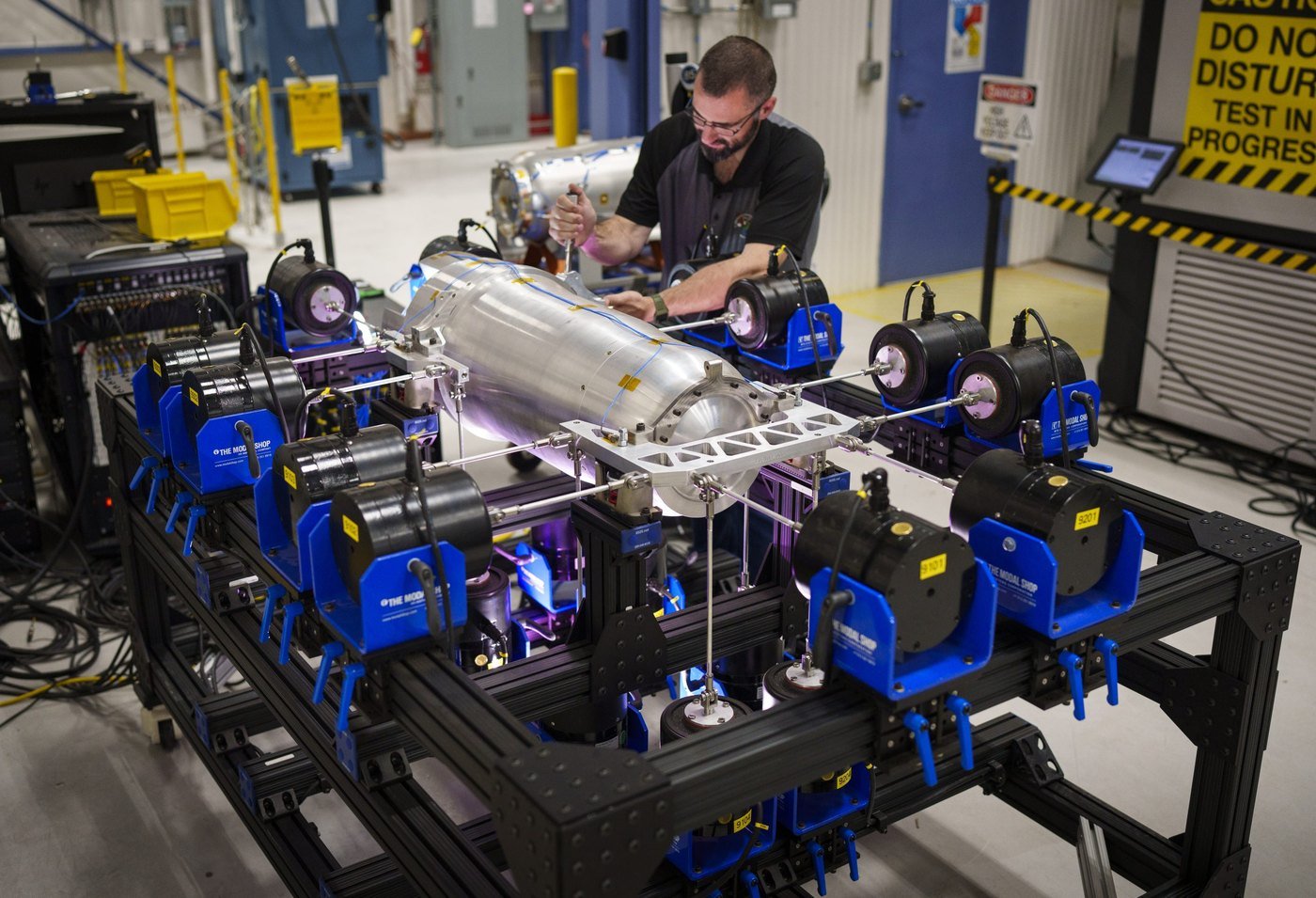
Six Degree of Freedom (6-DOF) vibration testing excites a test article in all six rigid-body degrees of freedom at once: the three translational axes (vertical, lateral, longitudinal) and the three rotational axes (roll, pitch, yaw). It is a specific application of MIMO control applied to a multi-actuator table or fixture. The result is a fully three-dimensional input that captures simultaneous and cross-axis effects a single-axis test cannot.
Multi-axis testing earns its place when a single-axis test does not represent the real environment, when cross-axis coupling changes the answer, or when total test time across multiple axes is a constraint. The payoff is threefold: a more realistic and defensible dataset, the ability to see simultaneous multi-axis effects that sequential testing hides, and a significant reduction in test time because the axes run together instead of one after another. For high-consequence hardware, that combination of realism and efficiency is usually the reason a program moves to MIMO or 6-DOF.
MIMO and 6-DOF testing require simultaneous multi-exciter drive and matrix control that most labs are still building capability for. KCSC has developed and run these methods on real programs, which means a partner who can stand behind the setup, the control, and the result.
A multi-axis test is only as good as the way it is set up and controlled. KCSC builds each campaign from the requirement outward, then verifies the control before the article sees full level.
Every engagement is documented so the result holds up to review. Depending on the scope, that includes the test plan and multi-axis profiles, the channel and control configuration, the verification record showing how closely the controlled matrix matched the target, the analyzed data, and a written report. When the test supports a model, KCSC provides the measured data and correlation support the analysis team needs.
Tell KCSC about the article, the environment, and the requirement. This page is the methods side of the work; see Structural Dynamics & Vibration Test for the full test, data, and analysis chain, or MIMO Test Frame Design if you are building the hardware that runs these tests.